Categorieën
Nieuws

Casualty Estimation in the MPP-CMPEC3 Medical Planning Framework

Written by Lennart Bongartz and Denys Surkov. Post 3 of 7 in the CMPEC3 series. Published in Military Medicine. Follow for Post 4: Materiel.

The Number That Anchors the Medical Plan


Before a single medical kit is packed or a CASEVAC route is plotted, the medical planner must answer the hardest question in battlefield medicine: how many casualties, of what type, arriving when, and from where?

Casualty Estimation is the first and most foundational component of the CMPEC3 framework. Every subsequent planning decision — materiel quantities, personnel requirements, evacuation asset allocation, treatment facility positioning — flows directly from the casualty estimate. The MPP-CMPEC3 framework breaks Casualty Estimation into four sequential sub-components: Population at Risk (PAR), Estimated Casualty Rate, Casualty Injury Profile, and Casualty Flow Analysis.


Population at Risk

PAR defines the total number of people under the medical team’s responsibility within the area of interest. This is broader than it initially appears. It includes own forces, adjacent units, attached elements, civilian contractors operating within the area, wounded enemy combatants (per Geneva Convention obligations where applicable), service animals, and — in Ukraine’s operational context — the humanitarian volunteers and NGO personnel who frequently operate outside formal military governance structures. The involvement of medical NGO’s operating outside formal clinical and military governance, further complicates oversight and poses risks to operational security.

Accurately scoping the PAR prevents both under-planning (insufficient resources for actual demand) and over-planning (diverting scarce assets to groups not under medical responsibility). In a large-scale combat operation involving multiple SOF elements, conventional units, and host-nation forces, the PAR must be agreed and documented — not assumed.

Estimated Casualty Rate

Defining this number is an analytical act, not a concession of failure.

The MPP framework requires that the casualty estimate for units below Brigade level converges on a single agreed-upon number of casualties against which the medical plan is resourced.

This number should be informed by the tactical mission type — attack, defend, patrol, ambush — as well as the medical estimate derived from the MDMP, available trauma registry data, or operational experience. Where two or more  COAs are under consideration in the Brigade planning process (e.g. most likely and most dangerous enemy COA), separate casualty estimates are developed for each, time allowing. The authors acknowledge that formulating a casualty estimate is challenging. A key question is at which echelon this estimate should be calculated. When absent or unreliable, we still advise doing a brisk but decisive casualty estimation to begin planning and to avoid “paralysis by analysis”.

Casualty Injury Profile

The Casualty Injury Profile characterizes likely wound patterns based on mission type, enemy capabilities, insertion method, and environmental factors. It involves selecting the probable ratio of Immediate, Delayed, Minimal, and Expectant triage categories.

For longer-duration missions, the profile should be divided per operational phase: for example Disease and Non-Battle Injuries (DNBI) during pre-staging, and battle casualties during execution.

Special considerations — hypothermia, chemical agents, altitude physiology, etc — are added based on mission-specific hazards.

The injury profile directly shapes materiel planning: a mission with a high proportion of penetrating trauma and blast injury requires different forward surgical and resuscitation capability than one dominated by DNBI and climate-related disease.

Casualty Flow Analysis

Casualty flow analysis estimates when and where casualties are likely to occur across the operational timeline and area of operations. This drives Casualty Collection Point (CCP) placement, evacuation route selection, and the distribution of medical assets across the battlespace. As the authors observe, “assume casualties can occur during any phase of the operation and determine efficient treatment locations and evacuation routes when constructing the evacuation scheme.”

This analysis is the direct precursor to the medical map overlay — the tangible planning product that makes the casualty estimate spatially actionable.


Medical plans must also realistically account for the limit trigger and maximum trigger thresholds, that determine when for example casualty redistribution is initiated or mission feasibility should be reassessed, respectively. This will be addressed in the Constraints & Limitations section.

#MilitaryMedicine #CMPEC3 #CasualtyEstimation #MedicalPlanning #NATOMedical #SmallUnitForces #CombatMedicine #LSCO #ForwardMedicine #MedicalMissionAnalysis
Categorieën
Nieuws

The Medical Planning Course to implement the CMPEC3 framework

Teaching medical planning with the CMPEC3 framework

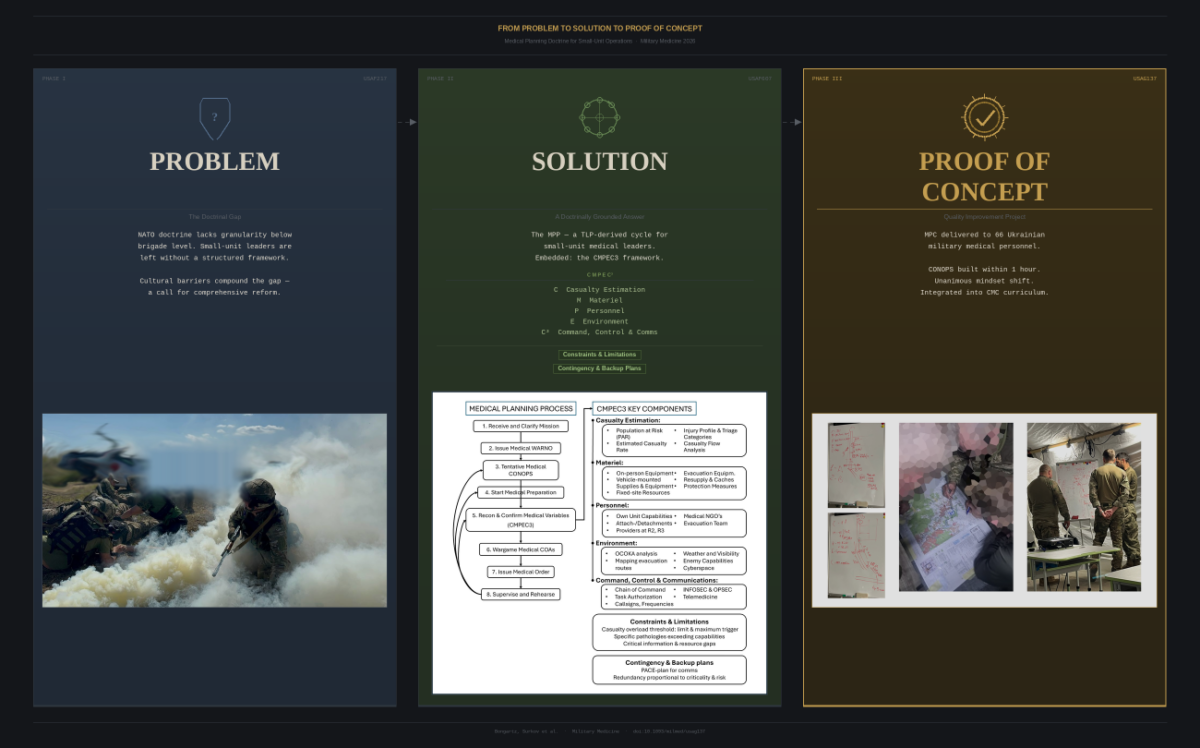
🪖 From *problem framing to *solution to *proof of concept — our latest paper is presently published in AMSUS – The Society of Federal Health Professionals Military Medicine Oxford University Press 📄 Full paper: doi.org(/)10.1093/milmed/usag137 (clickable link in comments)

Modern warfare in #Ukraine has exposed a critical gap in medical doctrine: Small-unit leaders — company level and below — are left without a structured medical planning framework precisely where the fight is most dangerous.

Since 2023, we’ve been working to close that gap, and this publication marks an important #milestone in that effort.

From “problem” to “solution”

The arc of our work:

Firstly, doi.org(/)10.1093/milmed/usaf217, we diagnosed the problem: NATO military medical planning doctrine lacks the granularity needed for small-unit operations, and cultural and organizational barriers compound the challenge.

Secondly, doi.org(/)10.1093/milmed/usaf607, we proposed the solution: the Medical Planning Process (MPP) — a TLP-derived, doctrinally grounded planning cycle for small-unit medical leaders, with the #CMPEC3 mission analysis framework (Casualty Estimation, Materiel, Personnel, Environment, Command, Control & Communications) at its core.

The MPC as Quality Improvement

Thus, in our newest report, we show results of first systematic implementation: the Medical Planning Course (MPC), delivered to 66 Ukrainian military medical personnel — combat medic graduates, senior enlisted, and officers — across multiple formats in Ukraine.

What we found:

✅ A basic medical CONOPS and evacuation scheme can be constructed within hours of structured practice.

✅ Students unanimously recognized the value of structured planning — including those initially skeptical.

✅ Real combat experience in the room, from veteran faculty and peers, validated the CMPEC3 components directly.

Likewise, the challenges in implementation were equally instructive: time pressure from command, the limited fit of NATO Roles of Care in the Ukrainian context, and the need to anchor planning in clinical triage and DCR/DCS rather than fixed-capability.

All in all, the most significant outcome was not a metric — it was a mindset shift. Personnel who arrived skeptical about the feasibility of planning left convinced of its value, with a completed plan in hand.

This is proof of concept of instructional utility and face validation.

The next steps are already being taken: formal validation, scalability, and integration into national doctrine and guidelines.

Grateful to work alongside this exceptional team: Denys Surkov, JOHN M QUINN V, EMT-P, MD, MPH, PhD, CIME, Casper F, Dimitry Kovtunenko, Dimitry Sherman

Tim Bongartz MD, MS, CTropMed, Al Giwa, LLB, MD, MBA, MBE, FACEP, FAAEM, and Professor Martin Bricknell CB OStJ.

The unsung heroes of this are the Ukrainian medics and commanders who gave their time — in a warzone — to make this possible.

#MilitaryMedicine #CombatMedicineTraining #NATO #CMPEC3 #MedicalPlanning #Ukraine #TCCC #SmallUnitTactics #DoctrinalDevelopment #LSCO #MedicalEducation #Casualtycare #MPP #ArmedForcesofUkraine #MilitaryEducation

Categorieën
Nieuws

The Medical Planning Process and the CMPEC3 Framework

March 4, 2026

New post on LinkedIn


A series on Small Unit Medical Planning

by Lennart Bongartz and Denys Surkov

They need standardized and strong tools to plan and execute their operations, as improvisation just won’t make the cut in a high-tempo, high-casualty LSCO environment


Ukraine’s military medical system carries a heavy legacy of post-Soviet cultural tendencies, and has struggled to deliver coordinated casualty care at the frontline. Medical teams are routinely excluded from mission planning, commanders retain ad hoc control over CASEVAC assets, and the After-Action Review culture essential for improvement is largely absent. As we and our co-authors document in the Commentary (Military Medicine, 2025), these are not isolated incidents but is largely a systemic issue. In some instances, Ukrainian medical teams have adapted at an amazing pace, up to the point where they outpace NATO.

Firstly, many of the adaptations to tactical combat casualty care (TCCC) have been codified in Ukrainian medical practice guidelines and provide valuable lessons that helped shape TCCC Guideline updates primarily for point-of-injury (POI) care. On the other hand, a fatalistic attitude towards timely evacuation and thus escalating treatment can be observed, both in Ukraine and in the West. The proliferation of (fiber-optic) drones has created a zone up to 35-50 km deep, where any movement is detected almost instantly. This has led some to conclude that evacuation times of 72 hours or more is the standard planned parameter.

However, we posit that this overlooks the fact that inefficient medical planning is the rule rather than the exception, and that worst-case scenarios tend to get the attention. Where effective tactics, techniques and procedures (TTPs) have been applied – that actually make these medical interventions and casualty evacuation (CASEVAC) fall into place – they had not yet been adequately identified or appraised.

Striving for long-term impact

Accordingly, to ensure long-term systemic change, we started building a medical mission planning approach for our Ukrainian colleagues, not only to reduce the need for improvisation but also as an approach to gather future medical planning data. To liberally quote Michael Hetzler: “90% of what we do in medicine is reactive, but 80% of our succes depends on planning.”

Nor is NATO immune to this problem. The “command transformation” process in Ukraine has been arduous, and many even propose to reverse the flow of learning. Its own doctrine designates the Brigade as the lowest echelon for tactical planning (per APP-28). Below that — at company, platoon, and small-unit level — standardized guidance to plan medical support is heterogeneous, often audience-specific or even outdated. Existing handbooks differ in structure and analytic framing, making cross-unit interoperability difficult and reproducibility unreliable. In a multinational LSCO environment with high casualty rates and contested logistics, this gap could prove to be operationally dangerous.

Building on established practices

The answer is not to abandon proven methodology. The U.S./NATO planning methodologies like the Troop Leading Procedures (TLP) and mission analysis frameworks like METT-TC(I) and factor analysis exist because structured planning under cognitive load outperforms improvisation. This is exactly what the Medical Planning Process (MPP) and CMPEC3 framework aim to provide. Developed through multinational operational analysis and field-validated in Ukraine, the approach closely aligns with above-described methodologies but refocuses them for the medical leaders and providers. By closely mirroring TLP, the MPP helps to align small-unit medical commanders with their tactical counterparts, creating mutual trust and benefit. The CMPEC3 framework allows for comprehensive mission factor analysis to formulate actionable outputs, leading to medical concept of operations (CONOPS).

The upcoming series of posts walks through the main components of the construct, from mission framing to contingency planning.


Further reading:

Learn or Lose: Lessons from Ukrainian Training in Germany (MWI)

→ Batchinsky A, Gumeniuk K, Holcomb JB. Clues to survival in future LSCOs are to be found in the current war in Ukraine. Trauma Surgery & Acute Care Open. 2025;10:e001962. https://doi.org/10.1136/tsaco-2025-001962

Disruptive Medicine for Denied Battlespaces (Irregular Warfare Center)

Drone Warfare Requires a New Age of Battlefield Medicine (Military Times)

Seven Lessons for Military Planners (MWI)

RAND: Sustaining the Fight

→ Krueger Izaguirre, Cox, Lodi et al. To Conserve Fighting Strength in Large-Scale Combat Operations. Military Review. March 2025 Online Exclusive Article

→ Beldowicz, Bellamy, Modlin. Death Ignores the Golden Hour. Military Review. March-April 2020.

#MilitaryMedicine #CMPEC3 #MedicalPlanning #NATOMedical #SmallUnitForces #LSCO #CombatMedicine #Ukraine #ForwardMedicine #MedicalDoctrine

Professor Martin Bricknell CB OStJ JOHN M QUINN V, EMT-P, MD, MPH, PhD, CIME Dimitry Kovtunenko Konstantin Gumeniuk Al Giwa, LLB, MD, MBA, MBE, FACEP, FAAEM